Frontal fibrosing alopecia associated with lichen planopilaris: A pediatric case
Downloads
DOI:
https://doi.org/10.26326/2281-9649.36.3.2943How to Cite
Abstract
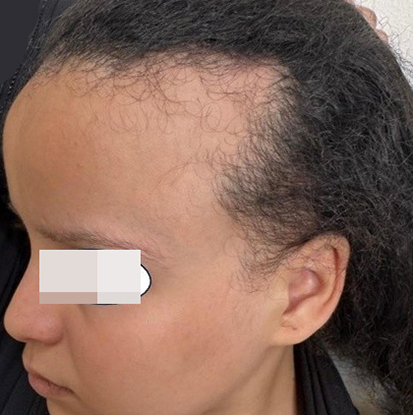
Frontal fibrosing alopecia (FFA) is a variant of lichen planopilaris, characterized by lymphocytic scarring alopecia mainly affecting the frontotemporal hairline. It predominantly occurs in postmenopausal women, while pediatric cases remain extremely rare. We report the case of a 12-year-old girl presenting with progressive hair loss over three years, initially involving the temporal areas and later becoming diffuse with eyebrow involvement. Clinical examination revealed decreased scalp hair density, recession of the frontal and temporal hairline, loss of vellus hairs along the frontal margin, and the presence of “lonely hairs.” Trichoscopy demonstrated perifollicular erythema and scaling, absence of follicular openings, and single hair emergence per follicular unit. Typical features of Alopecia areata, such as black dots, exclamation mark hairs, and yellow dots, were absent. A biopsy taken from the inflamed advancing margin, guided by dermoscopy, showed a perifollicular lymphocytic infiltrate involving the isthmus and infundibulum with interface dermatitis and basal cell vacuolization, confirming the diagnosis of FFA associated with lichen planopilaris. The patient was treated with oral corticosteroids, doxycycline, monthly intralesional betamethasone injections, and vitamin D supplementation. After six months of follow-up, clinical improvement was observed with complete eyebrow regrowth and partial scalp hair regrowth, while the hair pull test became negative and trichoscopy showed vellus and regrowing hairs. This case highlights the importance of considering FFA and LPP in the differential diagnosis of pediatric scarring alopecia and emphasizes the value of dermoscopy in guiding diagnosis, biopsy selection, and disease monitoring.